
PDCA — Plan-Do-Check-Act
In plain English
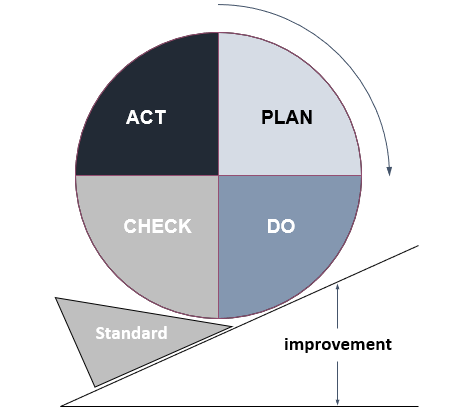
PDCA means Plan-Do-Check-Act.
It is a simple method to improve a process step by step.
It exists so changes are tested and measured before they become “the new way.”
Plan: Decide what problem you are fixing and what result you want. Pick one measure.
Do: Try a small change.
Check: Look at the results using the measure.
Act: If it worked, make it the standard. If it did not, adjust and try again.
What they actually mean
On paper, PDCA is obvious.
In reality, it often turns into:
- Plan as a slide deck
- Do as a big rollout
- Check as a meeting with opinions
- Act as “we’ll circle back”
It gets used as a permission slip to change things fast, not a discipline to learn.
Often confused with DMAIC or shoved inside a weak CAPA where “Act” never updates the process.
Uncomfortable truth: If you don’t define the metric and baseline up front, “Check” becomes storytelling.
When done right, it is boring: a small trial, real numbers, and an actual update to standard work so the next shift runs the improved process.
Example
A warehouse has late outbound shipments.
- Plan: Define the target (on-time %), baseline it, and pick one change to test (staging carts by route).
- Do: Run the test on one route for one week.
- Check: Compare on-time %, pick accuracy, and time-to-load vs baseline.
- Act: If it improved, update the work instructions and training. If not, adjust the idea and run another test.
Where you’ll hear it
- Operations: cycle time, throughput, staffing, workflow changes
- Quality: defect reduction, escapes, inspection effectiveness
- Engineering: process tweaks, line balancing, equipment settings
- Product: small experiments on features or user flows
- Leadership: operating rhythm improvements when metrics exist
Does it actually matter?
✅ Yes — when the work is repeatable and you can measure outcomes (quality, time, cost, safety).
PDCA matters because it forces a baseline, a small test, and a decision based on results — not opinions.
⚠️ Watch out: If leadership demands big launches or won’t let teams change standard work, PDCA becomes paperwork and nothing sticks.
Common misconceptions
- Myth: PDCA is just “try something and see.”
Reality: Without a defined metric and baseline, you can’t tell if you improved or just got lucky. - Myth: “Do” means implement the solution.
Reality: “Do” is a controlled test; skipping that turns learning into rework. - Myth: “Check” is a status meeting.
Reality: “Check” is data review against the plan; otherwise decisions drift to the loudest voice. - Myth: “Act” means announce the result.
Reality: “Act” means update standard work, training, and controls or the process snaps back.
Red flags
🚩 No baseline before the change.
Operational impact: “Check” becomes debate, and you can’t defend the decision to keep or kill the change.
🚩 Testing on the whole operation at once.
Operational impact: you create widespread disruption and can’t isolate what caused the result.
🚩 Check is done weeks later.
Operational impact: conditions change, data gets messy, and the learning is no longer reliable.
🚩 Act doesn’t touch standard work.
Operational impact: every team keeps their own version, variation returns, and metrics drift back.
Worth learning?
5/5
PDCA is simple, repeatable, and one of the fastest ways to build real improvement habits — if you actually measure and standardize.
Report an error
Found something wrong or misleading? Let us know — we want this site to stay fact-based (even when we joke).