
Day 1 — The Inbox (Revised Flow)
You arrive early.
New notebook. Clean desk. First real quality role.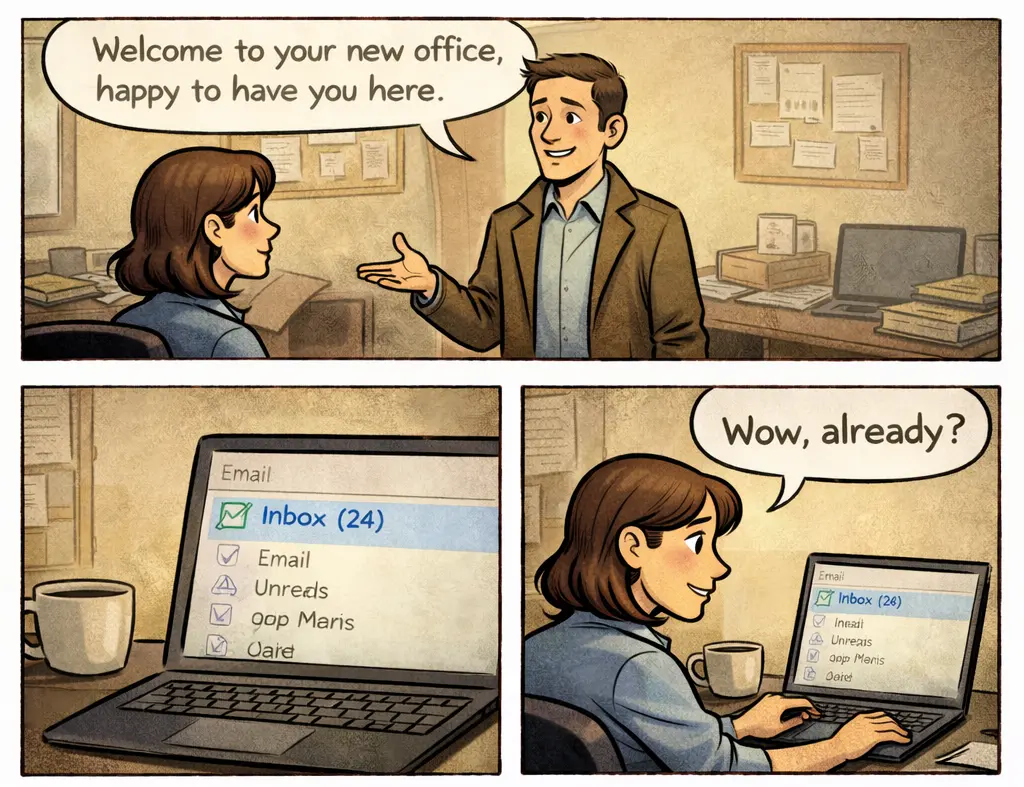
By lunch, you’ve already been pulled into:
- Incoming inspection questions
- A production stop
- A supplier complaint
- Three customer emails
You are told:
“You’ll handle incoming inspection approvals.”
“Production will check with you if something looks off.”
“Suppliers go through you.”
“Customer complaints too.”
It sounds manageable.
Until you open the inbox.
24 unread emails.
Some are active complaints.
Some are internal questions.
Some are customers waiting for answers.
You answer a few.
Then production walks in:
“Can you approve this batch?”
You look at the part.
You’ve been here six hours.
You don’t even know the full spec yet.
The Realization
By Day 3, something is clear:
You are not building quality.
You are reacting to it.
Incoming inspection is waiting for your approval.
Production interrupts you mid-email.
Sales forwards customer complaints directly to you.
The inbox keeps growing.
You stay late.
You still feel behind.
The Breaking Point
At the end of Week One, you try to answer a customer complaint.
You search for previous similar cases.
There is no log.
Just email threads.
Different people replying.
Different conclusions.
No summary.
You ask:
“How many open complaints do we have?”
No one knows.
That’s when it hits:
If I keep answering emails, nothing improves.
I will always be behind.
The Meeting
You request a meeting with your manager.
Not to complain.
To explain.
“If I personally handle every complaint, inspection approval, and deviation, we’ll stay reactive forever.”
“I need time to build a system.”
It’s not about avoiding work.
It’s about stopping repeat work.
Your manager pauses.
Then agrees.
For the next few weeks:
- Incoming inspection shares approval responsibility.
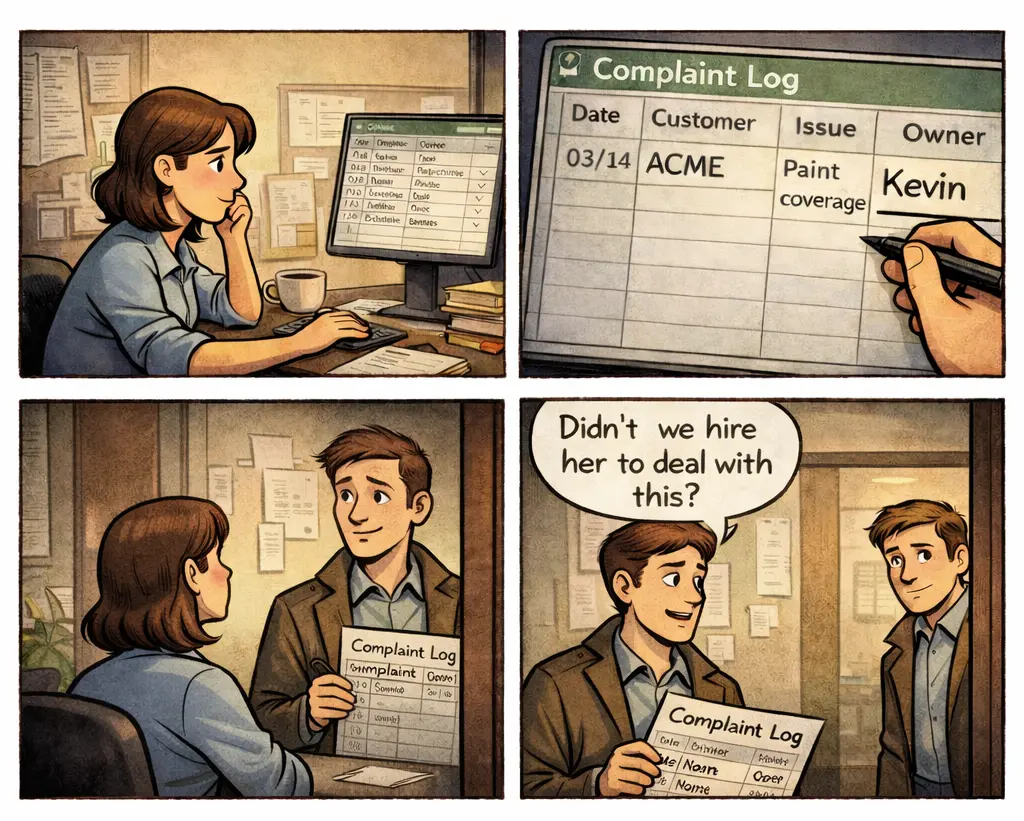
- Production makes defined calls within limits.
- Sales owns customer communication.
- You build structure.
That decision changes everything.
Not because the workload decreases.
But because the direction changes.
You are no longer trying to answer every issue.
You are building a structure that makes issues visible, traceable, and owned.
That shift — from reaction to structure — is the real beginning of quality.
Why Reactive Work Never Improves Quality
Reactive work feels productive.
You answer emails.
You approve batches.
You calm customers.
But nothing changes.
Why?
Because reactive work:
- Solves individual incidents
- Does not reduce recurrence
- Does not expose patterns
- Does not create ownership
- Does not build memory
If every issue is handled manually, the organization stays dependent on one person.
That’s not quality.
That’s firefighting.
The Core Problem: No System Memory
An inbox has no structure.
It cannot:
- Show repeat frequency
- Connect similar cases
- Assign long-term accountability
- Track time-to-close
- Reveal systemic weakness
Without structure, problems look random.
Random problems are impossible to fix permanently.
What Happens If You Don’t Build Structure?
If you continue working from the inbox:
- The same issue will return.
- Knowledge will live in conversations, not systems.
- Ownership will stay unclear.
- Response time will depend on who is available.
- When someone leaves, history leaves with them.
You might answer complaints faster.
But you will not reduce them.
Speed without structure is just faster chaos.
The Solution: Build a Simple Complaint Log
If this sounds familiar, start here.
Not with policy.
Not with ISO.
Not with new software.
Start with a structured complaint log.
Your objective in Week One is not improvement.
It is visibility.
That’s it.
Step 1 — Use a Simple Template
Do not overcomplicate it.
You need:
- Date received
- Customer
- Product / Order reference
- Short description of the issue
- Initial severity (basic classification is enough)
- Owner (by function)
- Status (Open / Investigating / Waiting / Closed)
That’s all.
👉 Download: Complaint Log Template
👉 Guide: How to Start a Complaint Log (Step-by-Step)
Step 2 — Move Everything Out of Email
If it is still active, it goes in the log.
No exceptions.
Old threads.
Half-resolved cases.
“That one we’re waiting on.”
If it’s not in the log, it doesn’t exist.
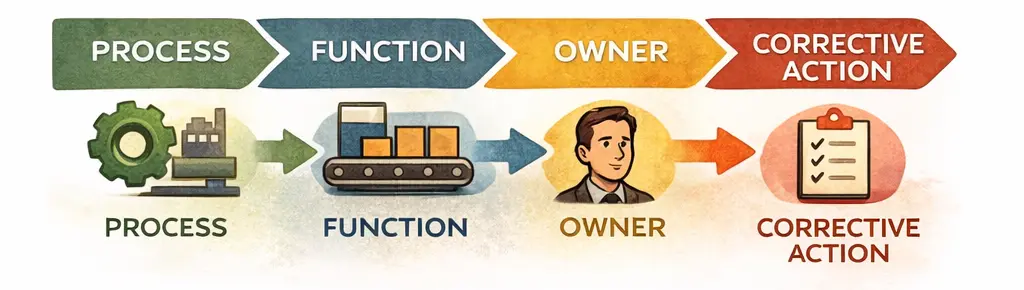
Step 3 — Assign the Correct Owner
Ownership follows function.
Ownership is not blame.
It is responsibility for improving the process that allowed the issue to occur.
Blame focuses on people.
Ownership focuses on systems.
That distinction matters.
- Production issues → Production investigates
- Supplier issues → Purchasing manages escalation
- Logistics errors → Logistics reviews process
- Drawing or specification gaps → Engineering clarifies
Quality does not “own” the defect.
Quality owns the system and the follow-up.
The rule is simple:
Who can change the process that allowed this to happen?
That function owns the case.
Step 4 — Make It Visible
A complaint log hidden on your desktop is useless.
It must be:
- Shared
- Accessible
- Reviewed regularly
Visibility without routine becomes noise.
Define a simple cadence:
- 15–30 minutes, once per week
- Review all open complaints
- Confirm ownership
- Confirm next action
- Escalate overdue cases
The log is not a document.
It is a management tool.
Visibility creates accountability.
And accountability changes behavior over time.
Step 5 — Do Not Optimize Yet
Do not build dashboards.
Do not redesign categories.
Do not write procedures.
In Week One, you are building control — not perfection.
Refinement comes later.
Right now, you are creating organizational memory.
What Happens Next?
Once everything is logged and visible, something shifts.
For the first time, you can see patterns forming.
Not conclusions.
Patterns.
And patterns lead to questions.
Why is this happening again?
Why is it always this customer?
Why does this defect appear every second week?
That is where root cause work begins.
But not before.
Week One is about control.
Week Two is about understanding.